
GCC desalination economics: power, contracts and the true cost of reliable water
Explore Gulf desalination through reverse osmosis, power-water coupling, procurement, tariffs, storage and environmental tradeoffs.
What you will understand
Desalination is a system commitment, not just a plant
For GCC economies, desalination links water security to electricity supply, public finance, coastal infrastructure and urban development. Producing freshwater from seawater can support cities and industry where natural freshwater is constrained, but the plant is only one part of the service. Intake, treatment, storage, transmission, distribution and maintenance determine whether water reaches users reliably and at a sustainable cost.
This makes desalination a different economic question from generic water scarcity. Gulf planners must coordinate long lived assets with changing demand and energy systems while protecting essential access. A low production tariff at the plant gate does not reveal the full cost of delivering a dependable cubic metre to a household or industrial site. The useful analytical boundary is the complete water service, including power and network dependencies. This guide examines those tradeoffs without ranking projects by promotional capacity claims or presenting hypothetical costs as current Gulf prices.
Thermal production connects water to the power schedule
Thermal desalination uses heat to separate freshwater from saline water. Historically, Gulf systems often combined power generation and water production, allowing the two outputs to share infrastructure and energy processes. This arrangement creates operating links: the economically preferred power schedule and the water requirement do not necessarily move together. Seasonal electricity demand can therefore complicate the operation of a system that must supply water throughout the year.
The IEA describes the regional transition toward electrically driven desalination as a change in this coupling, not simply a replacement of one machine by another. Evaluating a legacy plant requires understanding how heat, fuel and electricity costs are allocated between its outputs. A comparison that assigns all shared fuel cost to power can make water appear artificially cheap; allocating it differently changes the apparent result. Compare the whole system and the alternatives available, rather than drawing a conclusion from an unexplained unit cost.
Reverse osmosis shifts the dependence toward electricity
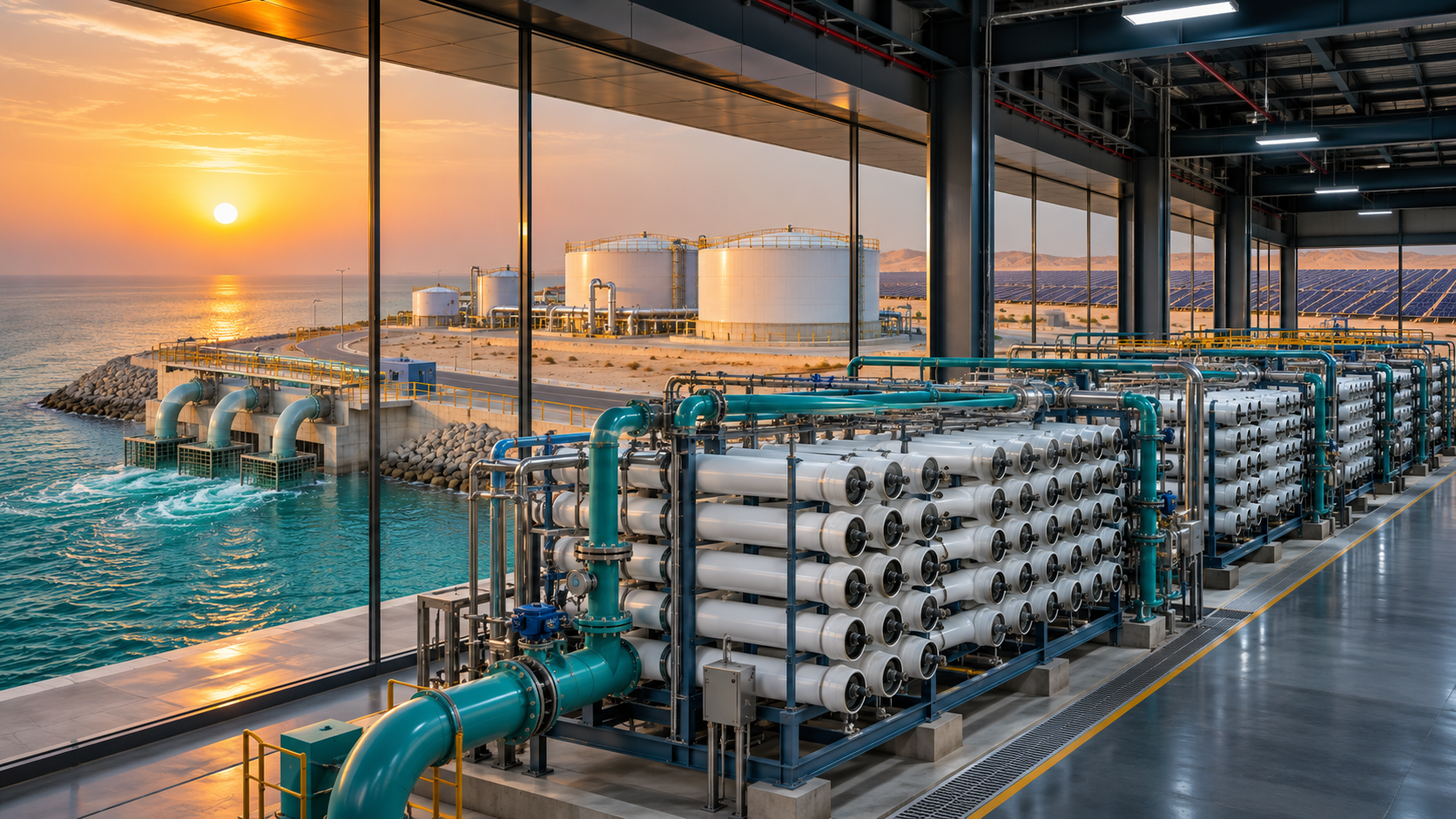
Seawater reverse osmosis uses pressure and membranes to separate freshwater from saline feedwater. It still requires pretreatment, pumping, post-treatment and management of the concentrated stream. The shift can reduce dependence on thermal cogeneration, but it does not eliminate energy dependence. Electricity reliability, membrane condition, source water characteristics and operating discipline remain central to cost and output.
Official Gulf procurement and utility material from SWPC, DEWA and EWEC documents the role of reverse osmosis in their planning and projects. These examples show the institutional direction without establishing that every site has identical economics. A hypothetical plant facing more difficult feedwater or a longer transmission route can have a different delivered cost from one using the same core technology elsewhere. Compare equivalent service boundaries and water quality requirements. A technology label alone does not reveal the full energy requirement, maintenance burden or resilience of the resulting supply.
Separate capital, operating and delivered costs
Desalination economics combines construction expenditure, financing, energy, chemicals, membranes, staffing, maintenance and network costs. A levelized production cost depends on assumptions about plant life, utilization, financing and future operating expenses. A bid tariff may allocate some risks to the buyer or rely on contractual inputs, so it should not automatically be compared with a full system cost from another project.
Consider a simplified hypothetical plant with annual fixed costs of 30 million units and variable cost of 0.40 per cubic metre. At 100 million cubic metres of annual output, average plant cost is 0.70; at 60 million, it becomes 0.90. The figures exclude transmission and other costs and are not market quotations. They show why utilization matters. A low variable cost does not make unused capacity free, and a headline price cannot be interpreted without understanding the output, contract and cost boundary behind it.
Procurement allocates risk as well as price
Independent water projects can use long term purchase agreements to support financing and define obligations between the producer and the buyer. The contract determines availability requirements, performance standards, payment mechanisms and the treatment of specified risks. Private financing does not mean that demand risk or contingent fiscal exposure disappears; it means those risks are allocated through a particular structure.
SWPC planning documents and published project disclosures illustrate the importance of purchase agreements in the Gulf model. For a hypothetical comparison, one bid can offer a lower stated tariff while leaving more energy or demand risk with the public purchaser. Another can include a different allocation and appear more expensive on the surface. Evaluate expected cost under plausible scenarios, not the first quoted number alone. The economic objective is reliable service at an acceptable lifetime cost, with obligations that remain manageable when demand, energy prices or financing conditions differ from forecasts.
Storage can separate production timing from use
Water storage and transmission networks can provide operational flexibility by allowing production and consumption to differ temporarily. This can help maintenance planning and resilience, and may support coordination with changing electricity conditions. But storage is not unlimited: volume, water quality, pumping capacity and network location determine what it can actually accomplish. A tank near one demand centre does not automatically protect another isolated part of the system.
A hypothetical utility might produce additional water during favourable power conditions and use stored water later. The value depends on storage losses, pumping needs and the ability to adjust plant operation safely. It should not be assumed that every desalination unit can follow electricity prices freely. Strategic reserves also serve a different purpose from routine daily balancing. Evaluate how many service interruptions a reserve can bridge under realistic demand and distribution constraints, rather than treating its nominal capacity as a complete measure of security.
Retail tariffs and system costs are different accounts
The household tariff is not necessarily the full economic cost of desalinated water. Public transfers, fuel arrangements, capital support or cross subsidies can create a gap between what users pay and what the system costs. That gap may serve social objectives, but it still requires funding and can affect incentives for conservation. Fiscal analysis should identify who ultimately bears the cost rather than assuming that a low bill means inexpensive production.
In a hypothetical system, a unit delivered at a total cost of two currency units but billed at one leaves a funding gap of one before collection losses. The numbers are illustrative. The policy question is how to protect essential access while sustaining maintenance and discouraging avoidable use. Targeted assistance, reliable metering and clear service standards can matter alongside tariff design. Comparing bills across GCC jurisdictions without checking customer categories, subsidies and service boundaries can produce misleading conclusions about efficiency or affordability.
Avoided demand can compete with new capacity
Desalination expands supply, but leakage reduction, efficient fixtures, better industrial processes and appropriate reuse can reduce the volume that must be produced and delivered. The comparison should use the cost of reliable service saved, not an abstract preference for supply or conservation. A network repair that avoids losses can reduce pumping and treatment needs, while a demand measure may have limited value if it merely shifts use to another time without reducing the relevant peak requirement.
A hypothetical repair programme saving ten million cubic metres annually can be compared with the lifetime cost of supplying that volume through new capacity and networks. Its benefit depends on verified savings, persistence and implementation costs. GCC water planning also needs to distinguish high quality potable demand from uses that could be served by appropriately treated alternative water. Matching quality to purpose can avoid unnecessary treatment, but requires safeguards, separate infrastructure where needed and reliable operational management.
The coast and the power mix remain part of the bill
Desalination produces a concentrated stream that requires appropriate management, while intake systems and chemical use can affect the marine environment. Impacts depend on site conditions, technology, discharge design and monitoring. UNEP and the UN World Ocean Assessment emphasize these factors rather than treating all plants as environmentally identical. In the Gulf, evaluating cumulative coastal pressures is more informative than assessing each outlet as though it existed alone.
Electricity emissions also depend on the generation mix and operating time, so an electrically efficient plant is not automatically a zero emission water source. Renewable procurement can change the picture, but claims should specify their accounting boundary and evidence. A hypothetical low cost site with difficult environmental mitigation may not remain the lowest cost option once safeguards are included. Evaluate intake, discharge, energy and ecosystem effects together. Responsible economic comparison includes costs that would otherwise be shifted to coastal users, public authorities or future restoration.
Judge the service over its full operating life
A useful GCC desalination assessment begins with demand, quality and reliability requirements, then compares technology and procurement options on consistent boundaries. Separate plant output from delivered supply, announced capacity from operating availability, and contractual tariff from total system cost. Examine energy dependence, storage, network resilience, maintenance and environmental obligations before drawing a conclusion from a record bid or a large capacity announcement.
The final question is which combination provides dependable water at an acceptable economic, fiscal and environmental cost under plausible future conditions. New production, demand management, reuse and network improvements can complement one another. The strongest strategy explains the role of each and tests what happens when demand or energy assumptions change. Desalination supports Gulf economic activity when it is integrated into a resilient service system; its value cannot be captured by a membrane specification, a plant size or a single price considered in isolation.
Test a scenario. Explore the market.
Hypothetical inputs for learning. Change the assumptions to see the arithmetic; these are not current market values or forecasts.
Same period for both inputs. Before taxes and fees. Formula: (1 + return) ÷ (1 + inflation) − 1. Methodology ↗
Input limits: returns, inflation and currency changes −99% to 1,000%; duration 0–30; yield changes −200 to 200 basis points.
Open an interactive market chart
Market context, not a direct measure of every subject in this article. Provider data may be delayed or unavailable. Check the instrument, quote currency and timestamp.
Open the full market workspace →Sources & further reading
Primary institutional sources underpin this educational guide. Follow the links for the original definitions, methods and research. Hypothetical examples in the text are explanatory, not current quotes or forecasts.
- IEA: Electrification and desalination ↗
- IEA: Middle East electricity outlook ↗
- IEA: Desalinated water and the energy equation ↗
- SWPC: Seven Year Statement 2024–2030 ↗
- DEWA: Water security and sustainability ↗
- DEWA: Water production technology assessment ↗
- EWEC: Water and electricity procurement ↗
- UNEP: Sustainable desalination ↗
- UNEP: Environmental assessment guidance ↗
- UN World Ocean Assessment: Desalination ↗
- European Commission: Desalination technology and costs ↗
Explore the data and markets
Continue your research
All guides →
GCC labour markets: skills, participation and the productivity of diversification
Connect Gulf diversification to skills matching, public-private opportunities, training outcomes, mobility and productive demand.

GCC aviation hubs: connectivity, transfer traffic and the economics of a global network
Assess Gulf aviation through usable connections, cargo, visitor value, capacity and fiscal and environmental tradeoffs rather than passenger totals alone.

GCC ports and logistics: when trade connectivity becomes economic diversification
Assess Gulf logistics through hinterland links, customs, free zones and domestic value added rather than container counts alone.