
GCC ports and logistics: when trade connectivity becomes economic diversification
Assess Gulf logistics through hinterland links, customs, free zones and domestic value added rather than container counts alone.
What you will understand
A port is an interface, not an economy by itself
For GCC economies, ports can connect domestic production and consumption with international shipping networks while supporting regional distribution. Their diversification value depends on what happens beyond the quay. A terminal handling more containers can generate additional service income, but durable gains also require reliable inland transport, efficient border processes, capable suppliers and businesses that use the connection productively. Geography creates an opportunity; institutions and commercial decisions determine how much value is captured.
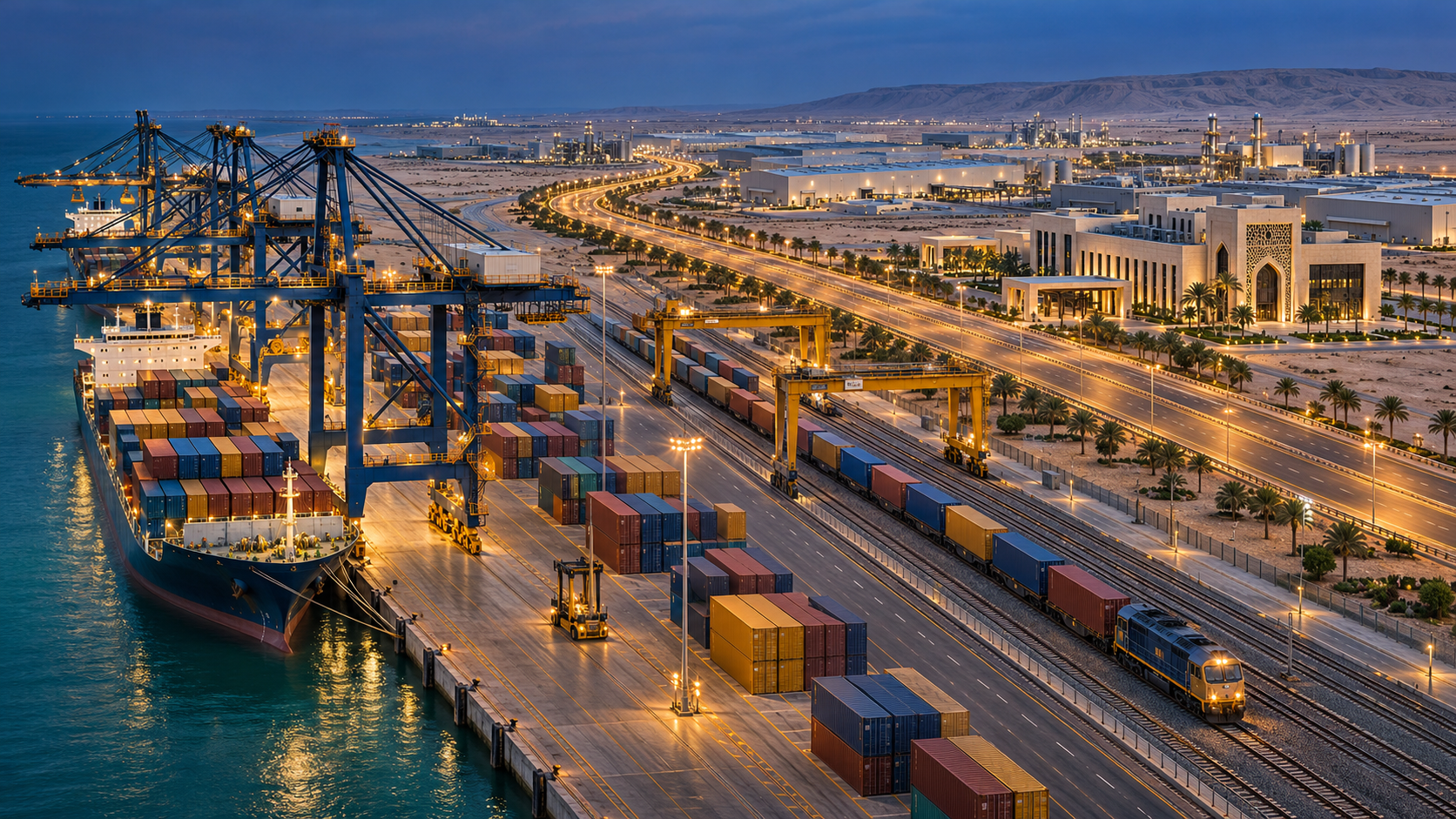
The right analytical unit is therefore the network linking ships, terminals, warehouses, industrial zones and final customers. UNCTAD describes ports as interfaces between maritime connectivity and hinterland access. A fast crane cannot compensate fully for delayed documentation or an unreliable road connection. This guide evaluates that network rather than ranking Gulf cities by promotional claims. The central question is whether logistics lowers the cost and uncertainty of doing business while creating income and capabilities that remain in the domestic economy.
Throughput is activity, not domestic value added
Container throughput measures handling activity, commonly in twenty foot equivalent units. It does not directly measure the value of cargo, the domestic content of trade or the income earned by residents. Transshipment can involve cargo moving between vessels without entering the local consumer or production economy. Re-exports involve a different trade relationship and should not be confused with domestic exports simply because goods leave through the same port.
Consider a hypothetical port that handles a high value imported machine and another that handles many low value containers. Neither cargo value nor container count alone establishes which produces more local value added. Handling fees, storage, repair, distribution and local processing create different revenue streams. The purchase value of a foreign good is not newly created domestic output when the good is shipped onward. A useful assessment separates cargo movement, service revenue and domestic production instead of presenting them as interchangeable evidence of diversification.
Reliability can matter more than the fastest average
Port users care about the full distribution of delivery times, not just an attractive average. An occasional long delay can require extra inventory, disrupt production or make a supplier miss a retail season. A route with slightly longer but predictable transit may therefore be commercially preferable to a faster route with frequent uncertainty. The economic cost of logistics includes financing and reliability as well as the freight invoice.
In a hypothetical example, goods worth one million currency units are delayed for ten additional days. At an illustrative annual financing rate of eight percent, the simple financing cost is about 2,192 units before storage, spoilage or lost sales. This is not a quoted market rate. It shows why a border reform can matter even without changing the shipping tariff. Measure vessel time, cargo dwell time and end to end delivery separately, because improvements in one stage may merely move the bottleneck elsewhere.
The hinterland determines usable connectivity
A shipping service creates limited benefit if cargo cannot reach the factory, distribution centre or neighbouring market efficiently. Roads, rail, dry ports, warehouses and border crossings form the hinterland connection. Their value depends on operating schedules, interoperability and commercially usable capacity, not merely the existence of infrastructure on a map. A rail link with poor terminal coordination can leave customers relying on road transport despite substantial investment.
For GCC diversification, the question is which production and distribution activities the corridor makes viable. A hypothetical manufacturer may choose a location because it can receive inputs reliably and serve several markets with manageable inventory. Another may find that a missing last mile connection cancels the port advantage. Analyse the complete shipment path and alternative routes. Building more berth capacity when the inland gate is already constrained can increase capital costs without proportionately improving the service businesses actually receive.
Border coordination is part of the infrastructure
Customs and other border agencies determine how quickly compliant goods can move while protecting legitimate regulatory objectives. Pre-arrival processing, risk management, electronic payment and coordinated information submission can reduce avoidable delays. The WTO Trade Facilitation Agreement provides an international framework for these practices, but the existence of a digital portal does not alone establish that agencies share data or make timely decisions.
The GCC customs framework creates a regional context for movement, while actual treatment still depends on product, origin, procedure and applicable national implementation. This is an economic explanation, not shipment specific customs advice. A hypothetical trader entering the same information into several disconnected systems may face little improvement from nominal digitization. Measure release times and their variation, identify repeat inspections and examine whether low risk goods move predictably. The objective is effective control with lower friction, rather than equating facilitation with the absence of oversight.
Free zones need operating links to create value
Free zones can combine logistics access, serviced land, administrative arrangements and customs treatment that support particular activities. Their economic contribution depends on firms actually using those features to store, process, assemble, repair or distribute goods. A company registration or a warehouse lease does not by itself show technology transfer or deep integration with domestic suppliers. Official operator descriptions illustrate the intended ecosystem but should not be treated as independent proof of every claimed benefit.
A hypothetical distributor may begin with simple storage and later add packaging, quality control and regional inventory management. Those functions can increase local service value without turning the entire cargo value into domestic production. Conversely, an isolated zone can remain dependent on imported inputs and external expertise. Evaluate tenant activity, employment quality, procurement and business survival. Also distinguish the zone's customs perimeter from the wider domestic market, since movement between them may trigger procedures and charges under applicable rules.
Shipping networks create both reach and dependence
Liner connectivity can expand the set of markets served and the frequency of sailings, but shipping networks are commercial systems that change with demand, fleet deployment and route conditions. A terminal heavily reliant on transshipment can be exposed to decisions by a small number of carriers. Strong throughput in one period does not guarantee that the same network configuration will persist indefinitely.
A hypothetical hub may gain traffic when a carrier reorganizes services, then lose part of it when the network changes again. Domestic manufacturing links and a substantial gateway market can provide a different demand base, although neither eliminates external risk. Assess carrier concentration, route alternatives and the share of cargo tied to local economic activity. Ports also face maritime chokepoint disruptions and schedule changes that are not caused by terminal management. Performance comparisons should separate controllable operations from the external conditions under which those operations take place.
Capacity expansion must earn its economic case
Ports are capital intensive and often connected to publicly funded roads, land development and utilities. Expansion can relieve a real bottleneck, but it can also create underused capacity if demand assumptions are optimistic or competing projects target the same cargo. Financial returns to an operator and wider economic returns to the country are related but distinct. Public support can improve the first while leaving the second uncertain.
A hypothetical terminal with spare capacity may not need another berth as urgently as better gate scheduling or customs coordination. Compare alternatives using lifetime costs, realistic traffic, resilience and the value of reduced delay. Do not count the full cargo value as a project benefit. Include maintenance, connecting infrastructure and environmental requirements, and test weaker demand scenarios. The strongest investment case identifies the specific constraint being removed and shows why that intervention outperforms cheaper operational changes or a different use of public resources.
Diversification comes from capabilities as well as cargo
Logistics can support diversification through freight forwarding, cold chains, maintenance, trade finance, software, insurance and industrial services. These activities differ in skills, capital requirements and local income generation. A port strategy that measures only tonnes can overlook higher value capabilities or fail to notice weak domestic supplier participation. Training and business development matter when firms need to meet international service standards.
For example, a hypothetical cold chain cluster can help a domestic food producer reach distant customers with less spoilage. The economic gain includes the producer's improved market access, not just the terminal's handling revenue. Yet the gain must be demonstrated through actual sales, quality performance and costs. Track local supplier contracts, productivity and sustained employment alongside traffic. Diversification is stronger when logistics enables competitive businesses that can survive changing trade routes, rather than relying solely on rents from a temporarily favourable geographic position.
Read a port strategy through an economic scorecard
Begin with cargo type and distinguish gateway trade, transshipment and re-exports. Then examine vessel turnaround, cargo dwell, inland delivery, reliability and total logistics cost. The World Bank's Container Port Performance Index focuses on vessel time and should not be mistaken for a complete measure of national logistics or domestic value added. Pair operational indicators with employment, local procurement, service exports and industrial activity.
Finally, identify fiscal support, maintenance obligations and exposure to concentrated customers or routes. A larger port can be useful without being the best next investment, and a smaller operational reform can create substantial benefits without a dramatic skyline. The most informative GCC analysis explains which bottleneck changed, who gained and how the gain is measured. Diversification is demonstrated by productive links and durable income, not by treating container counts, cargo values and national prosperity as three names for the same thing.
Test a scenario. Explore the market.
Hypothetical inputs for learning. Change the assumptions to see the arithmetic; these are not current market values or forecasts.
Same period for both inputs. Before taxes and fees. Formula: (1 + return) ÷ (1 + inflation) − 1. Methodology ↗
Input limits: returns, inflation and currency changes −99% to 1,000%; duration 0–30; yield changes −200 to 200 basis points.
Open an interactive market chart
Market context, not a direct measure of every subject in this article. Provider data may be delayed or unavailable. Check the instrument, quote currency and timestamp.
Open the full market workspace →Sources & further reading
Primary institutional sources underpin this educational guide. Follow the links for the original definitions, methods and research. Hypothetical examples in the text are explanatory, not current quotes or forecasts.
- UNCTAD: Port interface ↗
- UNCTAD: Hinterland access ↗
- UNCTAD: Port performance and facilitation ↗
- World Bank: Container Port Performance Index ↗
- World Bank: Customs logistics indicator ↗
- WTO: Trade Facilitation Agreement ↗
- WTO: Trade facilitation overview ↗
- GCC Secretariat: Common Customs Law ↗
- UAE ICP: GCC Customs Union ↗
- WTO: GCC regional agreement record ↗
- Jafza: Manufacturing and logistics clusters ↗
Explore the data and markets
Continue your research
All guides →
GCC labour markets: skills, participation and the productivity of diversification
Connect Gulf diversification to skills matching, public-private opportunities, training outcomes, mobility and productive demand.

GCC aviation hubs: connectivity, transfer traffic and the economics of a global network
Assess Gulf aviation through usable connections, cargo, visitor value, capacity and fiscal and environmental tradeoffs rather than passenger totals alone.

GCC desalination economics: power, contracts and the true cost of reliable water
Explore Gulf desalination through reverse osmosis, power-water coupling, procurement, tariffs, storage and environmental tradeoffs.