
Understanding the Six GCC Economies Beyond Oil
A country-by-country framework for understanding Gulf diversification, public finance, productivity and non-hydrocarbon business models.
Diversification has more than one meaning
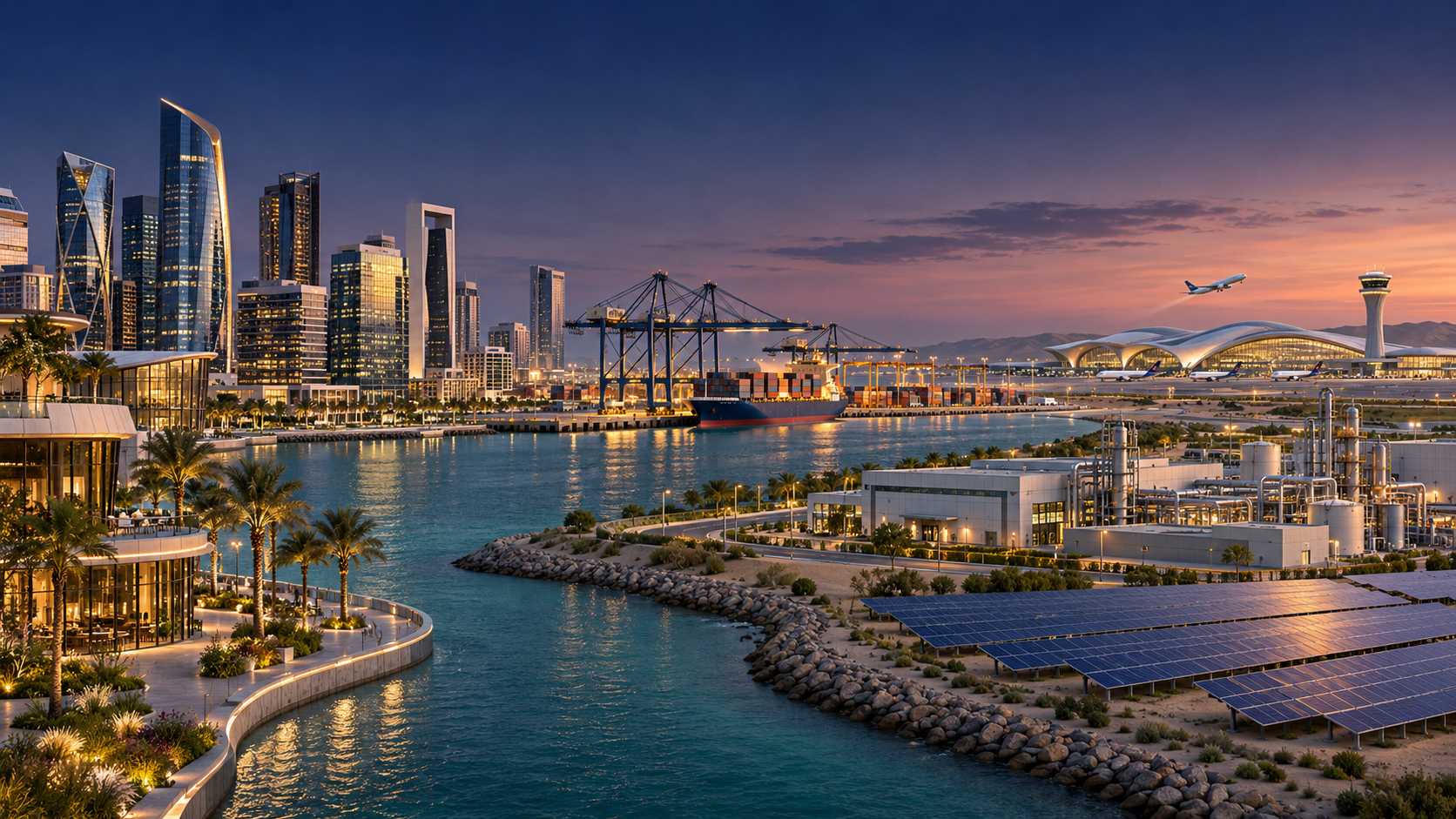
The six members of the Gulf Cooperation Council share important characteristics, but they do not form a single economic model. Bahrain, Kuwait, Oman, Qatar, Saudi Arabia and the United Arab Emirates have different populations, resource endowments, institutions and commercial specialisations. Understanding them requires separating three questions: what the economy produces, what earns foreign currency, and what finances government spending. A country can expand restaurants, construction and professional services while public spending remains sensitive to hydrocarbon revenue. That expansion is real economic activity. It does not automatically establish independence from energy income. Conversely, successful exports of services may strengthen an economy even when oil or gas still dominates headline merchandise exports. Diversification is therefore a set of connected transitions rather than a binary label.
Read national accounts before the skyline
A new airport or business district is visible; its net contribution is harder to measure. Start with real non-hydrocarbon value added, employment and exports, rather than the number of announced projects. Nominal sector shares can change simply because energy prices change. If oil prices fall, the non-oil share of nominal output may rise without any acceleration in non-oil production. Real growth measures reduce that particular distortion, although their classifications and base years still matter. Construction also deserves separate treatment: building an asset creates activity now, whereas operating it profitably creates a different stream later. For comparisons, record whether figures describe oil alone or oil and gas, whether they are nominal or inflation-adjusted, and whether they are annual results or forecasts.
Saudi Arabia: scale and the investment transmission
Saudi Arabia's large domestic market gives diversification a different starting point from smaller Gulf economies. Local demand can support supply chains, entertainment, tourism and business services at substantial scale. Public investment can establish infrastructure and initial demand, but the durable question is whether private businesses become competitive beyond government contracts. Imagine a hotel supplier that initially serves a publicly supported destination. Its next test is winning repeat commercial customers at prices that cover costs without exceptional support. Analysts should distinguish project commitments from expenditure, expenditure from completed capacity, and capacity from sustainable revenue. Strong headline investment can coexist with bottlenecks in skills, construction inputs or management. The useful question is how investment becomes productivity, rather than whether a particular development looks ambitious.
United Arab Emirates: connected service platforms
The UAE illustrates how trade, logistics, aviation, finance and tourism can reinforce each other. A company may use a port, an airport, professional advisers and regional financing within the same commercial network. These connections can generate value beyond any single sector. Yet the federation should not be treated as one homogeneous city: the economic structures of its emirates differ, including their exposure to hydrocarbons. Re-exports also require careful reading because gross trade values are not the same as domestic value added. A shipment passing through a logistics hub can support warehousing and transport without making its entire selling price local production. A serious assessment examines recurring business demand, skills, operating costs and resilience to changes in global trade and capital flows.
Qatar: gas income and a distinct services economy
Qatar makes the distinction between oil and hydrocarbons especially important. Calling activity non-oil does not necessarily remove natural gas exposure. Energy earnings can support fiscal capacity and investment, while aviation, hospitality and other services have their own operating economics. Analysts should therefore examine both the source of national income and the performance of individual commercial sectors. A transport business may have international customers and meaningful export earnings, yet remain exposed to fuel costs, route economics and global travel demand. Large events can temporarily lift utilisation, but a durable tourism assessment looks at ordinary periods as well. The central analytical task is to separate a resource-financed national balance sheet from the recurring commercial value created by service businesses.
Kuwait: wealth and domestic transformation
Kuwait demonstrates why accumulated financial wealth and domestic diversification must be analysed separately. Foreign assets can provide investment income and a national buffer, but owning overseas businesses does not automatically expand domestic private-sector productivity. Equally, a strong aggregate balance sheet does not mean every budget decision is unconstrained: liquidity, fiscal rules and the timing of revenues matter. For the domestic economy, examine business formation, competition, private employment and the relationship between public-sector incentives and private opportunities. A household may rationally prefer a stable public job even when policymakers want entrepreneurship. The relevant reform question is how institutions change those incentives while preserving essential services. Wealth offers room to act; its existence alone does not tell us how efficiently that room is used.
Oman: geography must become commercial advantage
Oman's ports, industrial activities and tourism potential offer a distinct diversification pathway. Geography can lower certain logistical frictions, but a port's location does not guarantee profitable cargo volumes. Customers also consider shipping connections, customs processes, inland transport, reliability and total cost. Manufacturing similarly depends on market access, skills and efficient inputs, not simply the existence of an industrial zone. A useful hypothetical comparison is between two factories with identical equipment: the one connected to reliable suppliers and customers may create more enduring value than the one benefiting only from cheaper land. For Oman, examine export quality, local supplier development and the fiscal implications of infrastructure alongside project announcements. The objective is commercially useful connectivity, not infrastructure capacity for its own sake.
Bahrain: services, industry and regional integration
Bahrain's financial services and manufacturing activities illustrate diversification in a smaller economy closely connected to its neighbours. A limited domestic market makes regional customers, cross-border access and specialised capabilities particularly important. Financial-sector size should be assessed alongside the quality of supervision, the sources of funding and the domestic value created through employment and services. Industrial output also needs a value-chain perspective: an energy-intensive producer may export non-oil goods while still being sensitive to energy inputs and global commodity cycles. Neither point negates diversification. Both explain its character. When evaluating Bahrain, ask which activities can retain customers through expertise, reliability and competitive costs, and which depend mainly on favourable external conditions. This distinguishes durable specialisation from temporary sector expansion.
The fiscal and sovereign-investment connection
Across the region, government budgets and sovereign investors connect hydrocarbon income to the wider economy in different ways. Public procurement can support a private contractor, while a sovereign fund may invest abroad or finance a domestic enterprise. These are not interchangeable transactions. Overseas investment can diversify national wealth without directly diversifying domestic production. Domestic investment can build productive capacity but may also compete with private firms or concentrate risk if projects share similar assumptions. Read mandates, financing structures and commercial performance separately. In a hypothetical downturn, a diversified portfolio might cushion national income even while local construction slows. Conversely, extensive domestic assets might be valuable over decades but difficult to turn into immediate budget cash. Assets, income and liquidity answer different questions.
Jobs and productivity complete the picture
Diversification should ultimately be examined through productive opportunities, not sector labels alone. More employees can raise total output without raising output per worker. Better skills, technology, management and competition can improve productivity, although measuring those gains takes time. Gulf labour markets also involve different incentives and conditions for citizens and expatriates, so aggregate employment may conceal important differences. A practical dashboard combines real non-hydrocarbon growth, non-hydrocarbon export earnings, private-sector job quality, productivity, fiscal revenue composition and exposure to external financing. No single indicator should become a league table. The six economies face different starting conditions and trade-offs. The strongest analysis asks whether businesses can repeatedly satisfy customers, develop capabilities and finance operations when extraordinary support or unusually favourable energy conditions fade.
Sources & further reading
Primary institutional sources underpin this educational guide. Follow the links for the original definitions, methods and research. Hypothetical examples in the text are explanatory, not current quotes or forecasts.
- IMF: Economic Diversification in the GCC: Past, Present, and Future ↗
- IMF: How Should GCC Countries Diversify Their Economies and Promote Inclusive Growth? ↗
- IMF: GCC Diversification: Role of Foreign Investments and Sovereign Wealth Funds ↗
- IMF: Pursuing Visions Amid Geopolitical Turbulence ↗
- IMF: Oman Selected Issues ↗
- World Bank: Gulf Economic Update series ↗
- World Bank: GCC Resilience, Diversification and Digital Transformation ↗
- IMF: Shaping the Future of the GCC Economy ↗
Explore the data and markets
Continue your research
All guides →
Sovereign Wealth Funds in the GCC: Savings, Stabilization and Development
Compare Gulf sovereign investment mandates through governance, liquidity, public balance sheets and measurable financial and development outcomes.

Productivity, Wages and Living Standards: How Economic Gains Reach Households
A practical guide to output per hour, capital deepening, multifactor productivity, pay distribution and the limits of economic averages.

Demographics and Ageing Economies: Work, Pensions, Care and Capital
How population age structures interact with employment, migration, pension systems and investment—and why demographic projections are not economic destiny.