
UAE — The Opportunity Economy: Gabriel Nicolaev–CyGuru on building a future in the Emirates
A book presentation exploring the decisions behind a UAE career, business or investment, and the difference between seeing an opportunity and building a sustainable position.
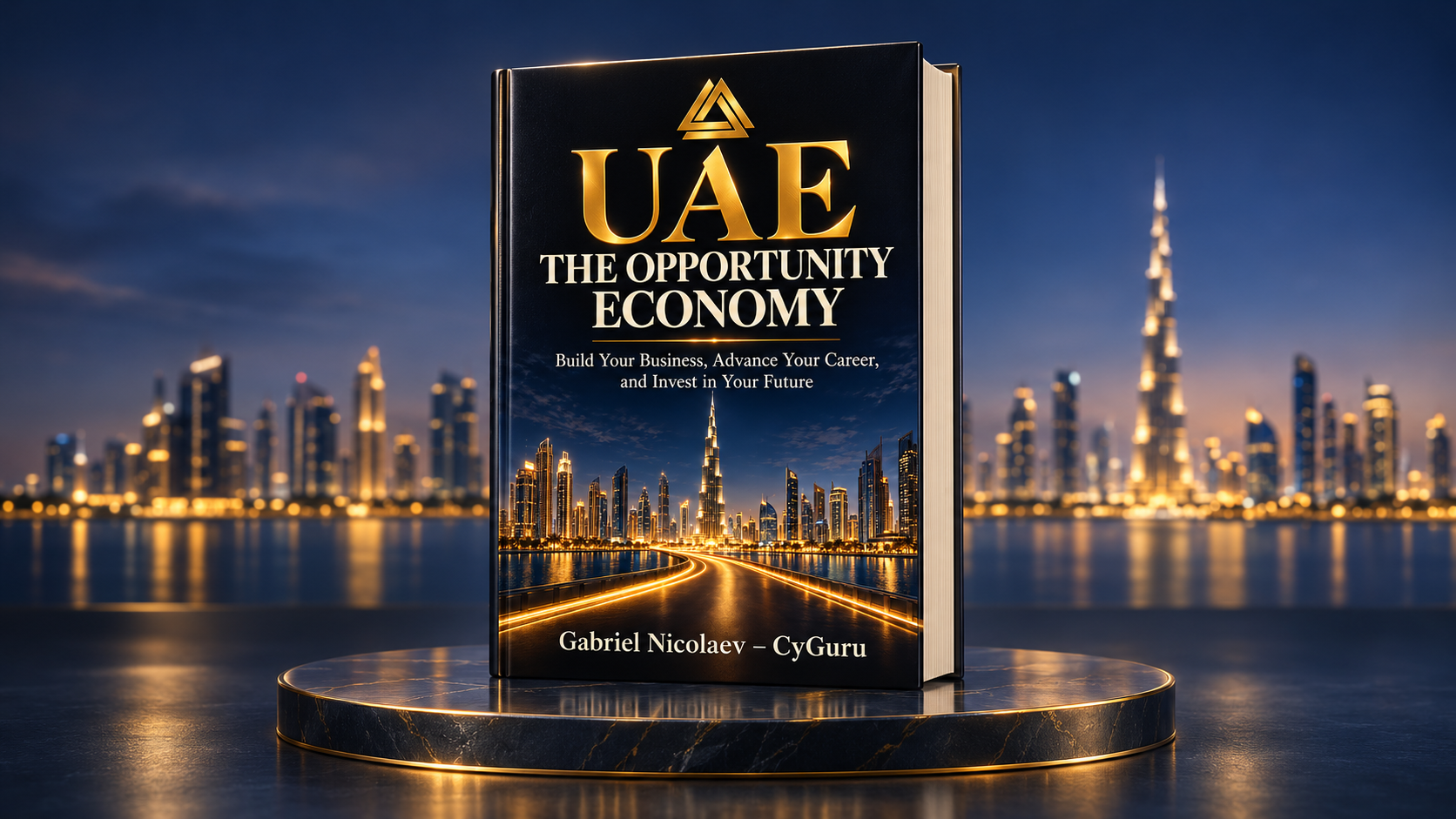
Author book presentation · Gabriel Nicolaev — CyGuru is the founder of CyEconomy.
Official book pages
The decision behind the destination
The United Arab Emirates can first appear as a destination: a place to visit, a skyline to admire or a market to investigate. A deeper commitment asks a different question. What would it take to work, build or invest there in a way that remains viable after the initial excitement? UAE — The Opportunity Economy, by Gabriel Nicolaev–CyGuru, addresses that transition. Its official presentation connects career development, business formation, investment judgement and the everyday decisions involved in establishing a life in the country. This feature introduces the book through that published description and offers editorial context for prospective readers. It is not a claim to have independently tested every argument in the complete volume, and it does not announce a new launch or promise a particular financial outcome.
An opportunity needs a person who can use it
The book’s public description presents the UAE as a place to discover, work, create and invest. The useful connection between those verbs is preparation. A market may contain considerable activity without offering the same opening to every participant. A professional brings a particular skill set, an entrepreneur brings an offer and an investor brings capital with a specific time horizon. Their constraints differ. Our reading of the book’s positioning is that the starting point should be the match between the person and the opportunity, rather than enthusiasm for the destination alone. The practical question becomes precise: which need can you serve, what evidence supports that judgement, and what resources are required before the idea can be tested under real conditions?
Career ambition must become a credible contribution
According to the official description, the book considers how career ambitions connect with market understanding and preparation. That is a more demanding question than whether a city appears attractive. A candidate needs to understand what employers or clients value, how that value can be demonstrated and where existing experience may require adaptation. In a hypothetical example, a capable manager can arrive with strong credentials but struggle to explain the commercial result those credentials support. The issue is not necessarily a lack of talent; it may be a weak translation between experience and the buyer’s problem. Readers exploring a professional move can use this distinction to examine their evidence, their network and the specific contribution they intend to make before committing to a new routine and cost base.
Registration and a commercial business are different milestones
A central point in the publisher’s presentation is that company registration begins an administrative journey, while customers determine the commercial future. The distinction is particularly relevant for readers who confuse the ability to establish an entity with proof that an offer will sell. A business needs a reason for customers to choose it, a workable delivery model and enough financial room to learn. Imagine a hypothetical service company with professional branding and completed paperwork but no repeatable route to qualified buyers. Its next constraint is unlikely to be another cosmetic improvement. It needs to test demand and distribution. This is editorial context around the book’s stated themes, not a description of an unseen case study or a promise that the volume replaces product and market research.
Investment judgement begins with the conditions
The official book page asks readers to evaluate an investment beyond its presentation, including assumptions, costs and conditions that could change the outcome. That framing gives the reader a useful discipline: separate the story from the mechanism that is supposed to produce a return. An attractive asset can still be unsuitable for a person who needs liquidity sooner than the investment can provide it. A persuasive projected return can depend on financing or exit assumptions that deserve independent checking. These are general decision principles, not recommendations about a particular UAE asset or transaction. The book’s relevance lies in bringing judgement into the conversation before commitment, while the reader remains responsible for obtaining current, transaction-specific information and the expertise appropriate to the decision.
The life around the plan has economic consequences
The book’s description includes where to live, cultural understanding and the everyday conditions that support a future in the UAE. These are not decorative additions to a business plan. Travel time affects available working hours; housing commitments affect the cash buffer; family routines affect how sustainable an intense work schedule becomes. Two people can receive the same income and experience very different degrees of flexibility because their obligations differ. Our editorial interpretation is that a serious opportunity assessment must include the life that makes execution possible. A plan that looks profitable only when rest, relationships and practical logistics are ignored may be fragile. The relevant question is whether the operating rhythm can be maintained, not whether a short visit felt inspiring.
Cultural understanding is part of execution
Gabriel Nicolaev–CyGuru’s official presentation places cultural understanding alongside career and enterprise. In practical terms, trust is built through conduct as well as competence: clarity, consistency, respect for commitments and the ability to listen. It would be a mistake to reduce a diverse country to one formula for communication or to assume that every sector behaves alike. The reader’s task is to learn the environment in which a particular relationship operates. A useful question is whether you understand how the other party defines reliability and value. This section offers context for the book’s stated emphasis rather than a catalogue of cultural rules. The deeper point is that an opportunity is often realised through relationships, and relationships require more than a technically correct proposal.
How to turn reading into a working document
A productive way to approach a book of this kind is to read with a live decision beside you. Write down the move being considered, the evidence already available, the assumptions still untested and the next reversible step. A professional might need to test how a particular skill is valued. A founder might need conversations with potential customers. An investor might need a more complete account of costs and exit conditions. These are suggested reading practices from CyEconomy, not a claim that the book contains this exact worksheet. Their purpose is to stop reading from becoming another form of postponement. A useful insight should eventually change a question, a test or a commitment; otherwise even a strong idea can remain disconnected from action.
Who is likely to find the book relevant
The official page identifies visitors considering a deeper connection with the country, professionals seeking a new direction, entrepreneurs preparing to build and investors looking beyond a single transaction. What joins these groups is the need to connect aspiration with practical commitments. The book is therefore positioned as a broad orientation to the opportunity landscape rather than a narrow manual for one administrative procedure. Readers seeking a specific current fee, regulation or contractual answer should verify that detail through the relevant authoritative channel. A broad framework and current operational information serve different purposes. The former helps decide what questions matter; the latter determines what can actually be done under today’s conditions. Keeping both roles clear allows the reader to use the book deliberately.
Explore the official book presentation
Readers can explore UAE — The Opportunity Economy on Gabriel Nicolaev–CyGuru’s official website through the link accompanying this feature. The page provides the author’s presentation and the available route to the book. The strongest reason to begin is a question that needs structure: what would a UAE move need to achieve, and what would it take to sustain it? The book’s published positioning brings that question across career, enterprise, investment and daily life. CyEconomy’s invitation is to approach it as a framework for examination, not as a substitute for evidence or a guarantee of success. An opportunity becomes meaningful when a person can identify the value they intend to create and build a realistic system for delivering it over time.
Official book pages
Continue exploring
Test a scenario. Explore the market.
Hypothetical inputs for learning. Change the assumptions to see the arithmetic; these are not current market values or forecasts.
Same period for both inputs. Before taxes and fees. Formula: (1 + return) ÷ (1 + inflation) − 1. Methodology ↗
Input limits: returns, inflation and currency changes −99% to 1,000%; duration 0–30; yield changes −200 to 200 basis points.
Open an interactive market chart
Market context, not a direct measure of every subject in this article. Provider data may be delayed or unavailable. Check the instrument, quote currency and timestamp.
Open the full market workspace →Sources & methodology
This presentation draws on the author’s official book description and the publicly available material linked above. The surrounding discussion is CyEconomy’s editorial context.
Editorial standards →