
Coffee and Cocoa: Weather Risk, Physical Markets and Retail Price Transmission
Separate coffee and cocoa crop risks, then follow quality, inventories, futures basis and processing costs through to consumer prices.
What you will understand
Coffee and cocoa share exposure, not identical biology
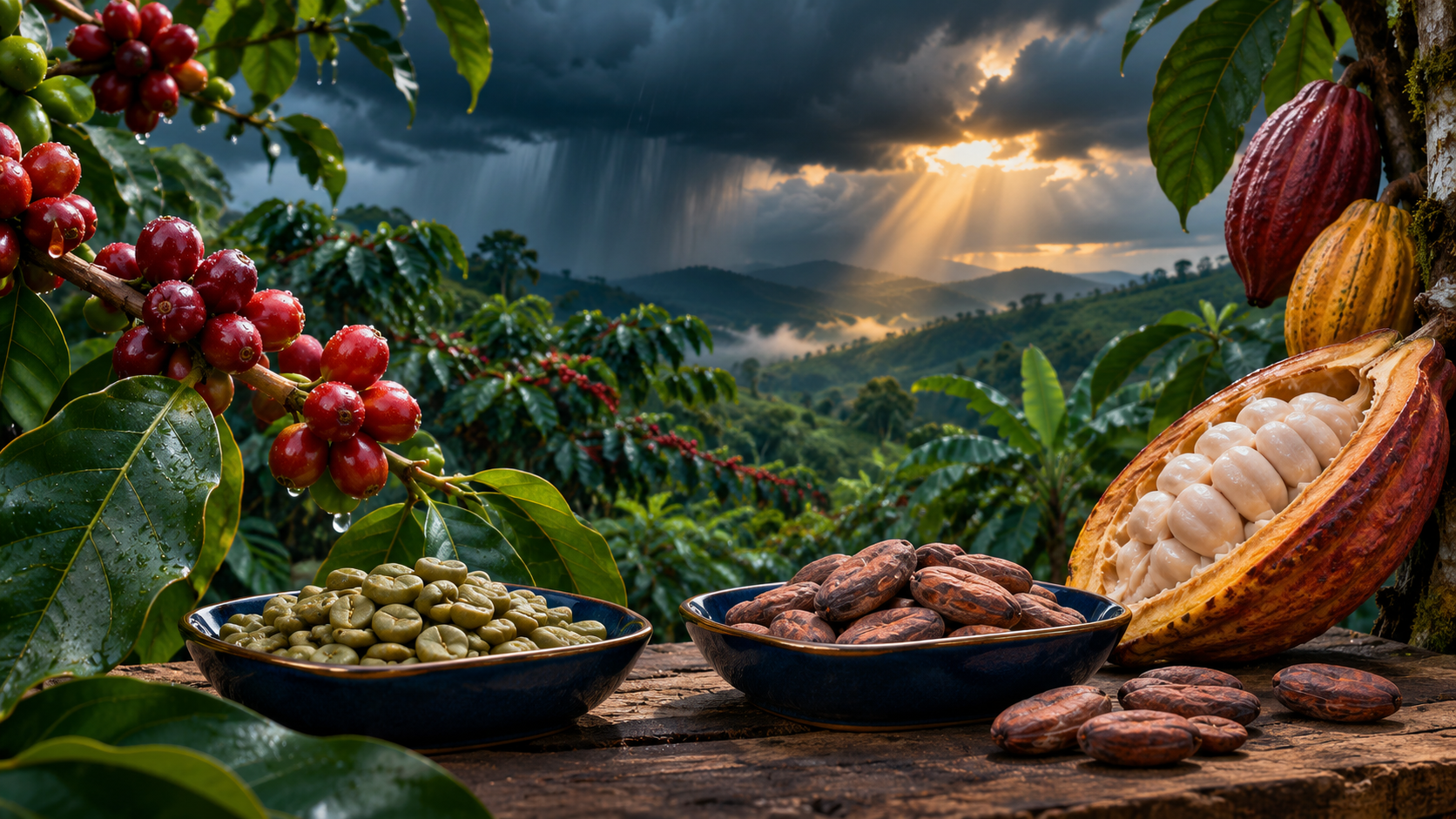
Coffee and cocoa are perennial tropical crops whose markets connect weather, farm management, processing and global consumption. Their prices can respond to similar broad concerns while their actual supply problems differ. Coffee includes commercially important arabica and robusta species with different growing requirements and uses. Cocoa develops pods on trees and passes through fermentation, drying and industrial transformation before becoming chocolate ingredients. A weather headline about one origin or species should not be generalized to all supply. This guide separates crop biology from exchange mechanics and retail pricing. The aim is to explain why a harvest concern can change a futures price quickly while a supermarket or café price moves later, differently or not at all. It does not provide a weather forecast, agronomic prescription or recommendation to trade either commodity.
Coffee weather risk depends on species and crop stage
Arabica and robusta occupy different production systems, and neither is immune to heat, rainfall disruption, pests or disease. Weather must be interpreted against flowering, fruit development and harvest timing. Rain can support growth in one period but disrupt harvesting or drying in another. A dry spell's effect depends on duration, soil moisture, irrigation and the plant's stage rather than the word drought alone. Production can also reflect tree age, pruning, inputs and the previous crop's demands. A forecast for a producing country is not the same as field-level evidence across its growing areas. Separate the probability of unfavorable weather from the estimated yield effect and the quantity ultimately exported. Market participants may revise expectations before physical losses are measurable, so a price move can reflect changed risk rather than a confirmed reduction in supply.
Cocoa combines pod development with tree-health constraints
Cocoa output depends on the development and survival of pods as well as the longer-term condition of trees. Rainfall distribution, heat, disease pressure and farm maintenance interact, so a single seasonal rainfall total can be an inadequate explanation of yield. Wet conditions may support growth yet complicate disease management or drying; prolonged dryness can stress trees and developing pods. Harvests often have major and minor peaks rather than one instantaneous collection date. Tree replacement and rehabilitation can improve future productivity but take time and may temporarily reduce output. Therefore, a higher price does not create mature productive trees by the next delivery month. Distinguish temporary weather-related losses from structural constraints such as aging trees or disease. The required recovery path differs, and market expectations should reflect that difference rather than assume every shortage resolves after one favorable rainy period.
Harvest volume and saleable quality are different measures
Post-harvest handling influences what reaches the market and at what value. Coffee cherries must be processed into green coffee through methods that affect quality and commercial characteristics. Cocoa beans require fermentation and drying, with handling conditions contributing to flavor development and defects. Rain at the wrong moment can create difficulties even after the crop has been picked. Moisture, contamination, bean condition and grading can change acceptance, discounts and storage suitability. A headline tonnage figure does not reveal the distribution of quality within that crop. Physical buyers need material suitable for their recipes or processing systems, not merely any bean counted in a production estimate. Examine quality differentials and rejection or certification information alongside harvest volumes. A market can have enough aggregate tonnage while remaining tight in the specific origins or grades required by particular customers.
Stocks buffer shocks, but availability is specific
Inventories connect one harvest to the next and can soften a temporary production shortfall. Their usefulness depends on location, quality, ownership and accessibility. Exchange-certified stocks represent material meeting a delivery system's requirements, not every bean held by farmers, exporters, processors or retailers. A decline in certified stocks may signal tighter deliverable supply, but it does not prove an identical decline in all global inventories. Conversely, ample total stocks may not meet a buyer's grade or timing requirements. Stocks-to-use comparisons can help organize analysis when both numerator and denominator share consistent definitions and crop years. Revisions matter because production, consumption and stock estimates are uncertain. Read inventory trends together with shipments, differentials and processing demand. A low stock figure is not a complete price forecast; it describes one part of the market's capacity to absorb unexpected events.
Futures and physical basis describe different price components
Coffee and cocoa futures reference specified delivery grades, locations and contract terms. Arabica and robusta have distinct benchmark contracts, while cocoa contracts also differ by market. The physical basis is the difference between a particular cash quotation and the relevant futures reference under clearly stated conventions. In a hypothetical same-unit example, futures at 200 and a physical differential of plus 20 imply 220 before other charges. If futures rise to 230 while the differential narrows to plus 5, the corresponding price becomes 235, an increase of 15 rather than 30. This is illustrative arithmetic, not a market quote. Origin, quality, freight and delivery timing can change the differential independently. A hedge against futures therefore leaves basis risk, and a futures move cannot be applied mechanically to every physical purchase.
Processing demand is not identical to final consumption
Coffee roasting transforms green beans into a product with different weight, characteristics and shelf-life considerations. Roasters manage blends, inventories and customer requirements, so purchases can diverge temporarily from cups consumed. Cocoa grinding creates liquor and, through further processing, butter and cake or powder. Demand for these outputs can move differently, affecting processing margins and purchasing decisions. Grinding statistics are useful evidence of industrial activity, but they are not a direct count of chocolate eaten. Inventory accumulation or liquidation can separate processing from final sales. A processor may also reduce activity because working-capital requirements have risen when raw material becomes expensive. Distinguish weak final demand from constrained financing or unfavorable processing economics. The same decline in throughput can result from different causes, each implying a different outlook for subsequent bean purchases.
Retail pass-through includes contracts and nonbean costs
A café drink or chocolate bar includes more than raw beans. Labor, packaging, energy, transport, rent, distribution and commercial margins also contribute to its price. Existing contracts and inventories can delay the effect of a commodity shock. In a hypothetical product costing ten units, suppose the bean-related component is two and all other components total eight. A 50 percent increase in that component adds one unit, producing eleven if every other component and the pricing policy remain unchanged: a ten percent increase, not 50 percent. Real pass-through can differ because firms change margins, package sizes, recipes or promotional intensity. Falling futures also need not reverse retail prices immediately if earlier costly inventory is still being used. Interpret consumer-price changes through the purchasing timeline and cost structure rather than assuming one-for-one transmission.
Higher prices encourage response, but trees impose delays
Strong prices can encourage improved farm care, harvesting effort or new planting, yet perennial crops cannot expand like a factory adding an extra shift. New trees require time to become productive, and weather, disease, labor and finance can constrain the response. Farmers may also receive prices that differ from international benchmarks because of currency, quality, marketing arrangements and local institutions. Consumers and processors can respond sooner by adjusting blends, recipes, inventories or purchasing patterns, although product expectations limit substitution. These different speeds can produce sharp price cycles: immediate demand adjustments interact with slow biological supply. Do not assume an elevated price guarantees rapid abundance or that consumers can substitute without consequence. A useful outlook specifies the response channel, the actors able to act and the delay before their decisions materially change available supply or demand.
Use a crop-stage and price-chain reading
Start with the crop, species or origin, and the relevant harvest period. Map weather evidence to the biological stage, then distinguish forecast risk from confirmed field outcomes. Check quality, export flows and stocks using consistent definitions, and compare certified stocks with the broader supply balance. Read the appropriate exchange specification before interpreting futures and physical differentials. Examine roasting or grinding alongside inventory and financing conditions, not as an automatic measure of final consumption. For retail transmission, identify contract coverage and the share of bean-related costs. ICO, ICCO, USDA, FAO, research institutions and exchange documentation provide complementary perspectives. Explicit hypothetical calculations can clarify mechanisms while avoiding unsupported price forecasts. A strong conclusion states which link is changing, when the effect should appear and what evidence would challenge that explanation.
Test a scenario. Explore the market.
Hypothetical inputs for learning. Change the assumptions to see the arithmetic; these are not current market values or forecasts.
Same period for both inputs. Before taxes and fees. Formula: (1 + return) ÷ (1 + inflation) − 1. Methodology ↗
Input limits: returns, inflation and currency changes −99% to 1,000%; duration 0–30; yield changes −200 to 200 basis points.
Open an interactive market chart
Market context, not a direct measure of every subject in this article. Provider data may be delayed or unavailable. Check the instrument, quote currency and timestamp.
Open the full market workspace →Sources & further reading
Primary institutional sources underpin this educational guide. Follow the links for the original definitions, methods and research. Hypothetical examples in the text are explanatory, not current quotes or forecasts.
- FAO: Coffee Facts and Global Perspective ↗
- CIRAD: Coffee Plant and Uses ↗
- ICCO: Growing Cocoa ↗
- ICCO: Harvesting and Post-harvest ↗
- ICCO: Processing Cocoa ↗
- ICO: Public Market Information ↗
- ICO: World Coffee Statistics Database ↗
- ICE: Coffee Markets ↗
- ICE: Robusta Coffee Futures ↗
- ICE: Cocoa Futures ↗
- USDA: Coffee World Markets and Trade ↗
Explore the data and markets
Continue your research
All guides →
Oil refining: crack spreads, product markets and the cost of turning crude into fuel
How crude quality, product yields, operating costs and inventories shape refining economics, with a worked 3-2-1 example.
Critical minerals recycling: collection, recovery and the economics of circular supply
Why installed metal is not immediately available scrap, and how collection, quality, recovery and commercial terms determine secondary supply.

Uranium Markets: Fuel-Cycle Services, Contracts and Security of Supply
Separate uranium material from civilian fuel-cycle services, then examine procurement schedules, inventory coverage and the economics of supply delays.